Membership Handbook: Difference between revisions
m Repoint order/directive references to the Orders namespace |
m Fix double Orders: namespace prefix on order/directive links |
||
| Line 482: | Line 482: | ||
|} | |} | ||
Promotion Policies are also outlined in [[ | Promotion Policies are also outlined in [[Orders:Admiralty Order 1701-01]]. | ||
Revision as of 21:09, 14 July 2026
This page reproduces the Membership Handbook (RMN 0-1), issued 5 March 2017 by the Bureau of Communications under the Office of the Fourth Space Lord. It is transcribed verbatim from the official TRMN PDF; the cover and organizational charts are reproduced as page images.

| HISTORICAL DOCUMENT — SUBSTANTIALLY SUPERSEDED This Membership Handbook (RMN 0-1) dates from 5 March 2017 and predates TRMN's incorporation and modern governance. Since the Bylaws (2022) and the Board Policy Documents, Joint Chiefs Directives, and the PD-SC policy series, large portions below — the organizational model, membership, ranks, and promotion policy — have been superseded or amended. Affected sections are flagged individually. It is preserved here as a historical record; for current policy see Portal:Policy. |
An Introduction to the Fan Association
Legal Disclaimer
Honor Harrington, the Honorverse, The Royal Manticoran Navy, The Royal Manticoran Marine Corps, The Royal Manticoran Army, The Grayson Space Navy, The Imperial Andermani Navy, The Republic of Haven Navy, The Sphinxian Forestry Service, The Royal Manticoran Merchant Marine, The Astro Control Services, Saganami Island Academy and other references to the works of David Weber or Final Sword Productions are used here under fair SSE laws and licensing terms. Information taken from Wikipedia is similarly used to comply with fair use laws. David Weber holds the copyright to all things related to the Honorverse and as such can at any time demand a change in this documentation, should it violate the fair SSE laws or the terms of the licensing agreement between The Royal Manticoran Navy: The Official Honor Harrington Fan Association, Inc and Words of Weber.
First Lord of the Admiralty's Welcome
Welcome to the Royal Manticoran Navy (TRMN) and all of her subgroups as we continue our now 10-year journey. We are the official fan association, dedicated to the Honorverse by David Weber. As such, we may be a bit different than other groups you have belonged to in the past. One of the nice advantages of the Honorverse is that so much is laid out for us that all we have to do is plug-and-play. There are, of course, some areas where we have freer rein to expand the group, such as the Royal Manticoran Army (RMA), but for the most part, we stick to what David Weber and the good folks at BuNine, a consulting group who works with Mr. Weber, have given us. I have been in fandom for over 20 years now, and one of my biggest complaints was that no organization ever managed to effectively teach its leaders how to lead a group. One of the main differences between TRMN and other fan associations that you will quickly notice is that we train our leaders to actually become leaders. One of the main ways we accomplish this is through Sagnami Island Naval Academy and the courses it provides to our members. It is in this way that members can be trained and promoted from the ground up to become leaders within the organization. As we place such an emphasis on leadership, you will find that we also offer resources to help members grow as a leader, including a first-class mentoring program which starts at the very top of the organization and flows down through the Royal Council to the various fleet and echelon commanders to the unit commanders. In a sense, think of it like the mentoring Raoul Corvousier imparted to Honor Harrington in the early novels. It is our hope that this program will help grow our leadership corps and also help to increase enjoyment in the group. We are a group wrapped in the cloak of the Honorverse, yet at the end of the day, this group is what you make it! We have policies in place to explain this cloak, especially in regards to things like peerage, rank, chain of command and other administrative things, but at the end of the day, we are a fan association and that means the fan aspects and the fun are most important. As you get more involved and join us either through chapter activities or convention activities, you will discover that the fun is never far away, and we hope that one day, you will step up and help to lead that fun.
In Service to the Fleet and in Honour of the Queen,
Martin Lessem, KSK, GCR, GCE, DSO, CGM, GS Admiral of the Fleet RMN First Lord of the Admiralty First Duke, New Scania
Organization
| This section was SUPERSEDED by the Bylaws, Orders:Joint Chiefs Directive 2311-04, and Orders:Joint Chiefs Directive 2406-01. TRMN governance is now vested in an elected Board of Directors with an Executive Committee and the Steering Committee, replacing the “five senior officers” and Royal Council model described below. |
The Royal Manticoran Navy: The Official Honor Harrington Fan Association, Inc. (TRMN), is organized along very simple lines. There are five senior officers of the organization: The First Lord of the Admiralty, the First Space Lord, the Commandant of the Royal Manticoran Marine Corps, the Marshal of the Royal Manticoran Army, and the High Admiral of the Grayson Space Navy. Each of these positions has a specific function which we will cover in this section.
First Lord of the Admiralty
| This section was SUPERSEDED by Orders:Joint Chiefs Directive 2401-01, the Bylaws, and PD-BOD-0002 Duties of the Board of Director Officers. The Office of the First Lord of the Admiralty was dissolved and reduced to an honorary, ceremonial title; its corporate and administrative duties were reassigned to the elected Board officers (President, Executive Vice President, Chief Legal Officer). |
The First Lord of the Admiralty (FLA) is the president (#1 in the corporate structure) of TRMN and serves as chairman of the board. This person is also responsible for coordinating the civilian population of the organization. For the work they do, this person is awarded the rank of admiral of the fleet. The duties of the FLA are as follows:
- Day-to-day running of the organization
- The issuing of regulations in the form of admiralty orders
- Chair of the peerage board
- Chair of the promotion boards
- Issuer of the Monarch’s Warrant for warrant officers
- Appointment of officers to the senior leadership position
- The official media contact of TRMN
- Responsible for calling and chairing the bimonthly Royal Council (executive board) meeting
- Responsible for chairing the annual membership meeting
- Responsible for overall role-play coordination
- The official legal contact through the Judge Advocate General (JAG) of The Royal Manitcoran Navy: The Official Honor Harrington Fan Association
- Coordinates the various civilian offices of TRMN (These will be explained in more detail later in this handbook):
- The Royal Manticoran Merchant Marine–Responsible for maintaining and commanding civilian chapters within TRMN
- The Royal Manticoran Intelligence Corps–Responsible for competitive intelligence gathering
- The Royal Manticoran Ambassadorial Corps–Responsible for outreach to other fan organizations. Coordinated by the staff communications officer
- The Royal Manticoran Astro Control Services–Responsible for coordinating chapter movement–Reports to Third Space Lord
- The Sphinxian Forestry Commission–Responsible for youth programs in the TRMN These duties may be expanded as necessary by admiralty orders, or delegated as appropriate to a staff officer in the Office of the First Lord of the Admiralty. The Office of the First Lord of the Admiralty consists of at least the following individuals:
- Chief of Staff–Usually a commodore or higher. Responsible for coordinating the staff in the Office of the First Lord of the Admiralty
- Staff Intelligence Officer–Usually a captain of the list or higher. Responsible for special projects and coordinating the events of various chapters, keeping records of same, suggesting same and acting as a resource for chapters when planning events. Staff consists of convention liaison officer. This officer is responsible for coordinating the efforts of the staff intelligence offices of all branches.
- Staff Communications Officer–Usually a captain junior grade or higher. Responsible for coordinating media contacts brought to TRMN. Additionally this officer will coordinate the ambassadorial corps which is responsible for liaising with other fan organizations.
- Chancellor of the Exchequer–This position does not necessarily come with a rank but would qualify for either a captain of the list / minister resident or higher. This person is the chief financial officer for TRMN and is responsible for basic administrative paperwork pertaining to the financial running of the organization. Their primary job is to serve as the financial arm of TRMN
- Judge Advocate General–Usually a captain of the list or higher. Responsible for legal affairs within TRMN, training and managing ombudsmen, recommendations for flag officer promotion boards, and is legal advisor for TRMN, Inc. As such, the JAG must be a qualified attorney. This office also oversees the JAG-ombudsman program which is set up to assist chapters with understanding regulations and admiralty orders within the organization.
- Staff Liaison Officer–At least a commander or higher. This position is responsible for coordinating all the awards of TRMN and her subsidiary groups. While real-world military experience is not required for this role, it is preferred.
- Aide-de-camp–Usually a commander or lower. Responsible for assisting the FLA with awards and presentations when at events. This position will be appointed on an ad hoc basis by each fleet as needed.
- Flag Lieutenant–Usually a lieutenant commander or lower. Responsible for the FLA’s schedule when at events. This position should coordinate with both the chief of staff and the aide-de-camp to ensure the FLA is kept on schedule. This position will be appointed on an ad hoc basis by each fleet as needed.
First Space Lord
| This section was AMENDED by Orders:Joint Chiefs Directive 2412-01. The First Space Lord is now styled Chief of Naval Operations (1SL) and is the senior uniformed officer of the RMN, no longer positioned beneath a First Lord of the Admiralty. |
The First Space Lord is the senior vice president (#4) of TRMN, deputy chairman of the board and chief executive officer of the administrative arm of the organization. For the work they do, this person is awarded the rank of fleet admiral. The duties of the FSL are as follows:
- Assist in the day-to-day operations of the organization
- The issuing of regulations in the form of naval directives
- Recommend officers for senior leadership positions
- The day-to-day operations of the Royal Manticoran Navy (RMN) subgroup, the meeting division of TRMN
- Appoints and coordinates with the fleet commanders on the status of the various fleets
- Coordinate the various administrative offices of TRMN (These will be explained in more detail later in this handbook):
- Second Space Lord–BuPlan–The Bureau of Planning and Administration. Oversees the space lords and coordinates their efforts. Also serves as the outreach officer to other organizations and Honorverse fans. This position is primarily the chief marketing officer.
- Third Space Lord–BuShips–The Bureau of Ships and Operations. Signs off on new chapters. This position is also the chief operations officer.
- Fourth Space Lord–BuComm–The Bureau of Communications. Coordinates the newsletter and websites of the Royal Manticoran Navy: An Honor Harrington Fan Association. This position is also the chief information officer.
- Fifth Space Lord–BuPers–The Bureau of Personnel. Maintains the membership section database and processes new and returning memberships. This position is also the Chief Personnel Officer.
- Sixth Space Lord–BuTrain–The Bureau of Training. Home of the Saganami Island Academy and the Instructors. This position is also the chief training officer.
- Seventh Space Lord–BuSup–The Bureau of Supply & Quartermaster. Responsible for the Quartermaster Division of the Royal Manticoran Navy: An Honor Harrington Fan Association. This person is also the chief logistics officer.
- Call and chair a bimonthly administration meeting of TRMN and inviting the FLA in addition to the Space Lords
- Call and chair meetings with fleet commanders as needed
- These duties may be expanded as necessary by admiralty orders or navy regulations. The Office of the First Space Lord consists of at least the following individuals:
- Chief of Staff–Usually a captain junior grade or higher. Responsible for coordinating the staff in the Office of the First Space Lord
- Staff Intelligence Officer–Usually a captain junior grade or higher. Responsible for working and coordinating with the FLA’s staff intelligence officer for event planning, keeping records of the same and suggesting the same for the RMN subgroup
- Staff Communications Officer–Usually a captain junior grade or higher. Responsible for facilitating the communication with the administrative officers (space lords) and arranging the monthly administration meeting
- Leadership Board Coordination Officer–Usually a captain junior grade. Responsible for coordinating the monthly meeting of regional commanders of TRMN
- Senior Master Chief Petty Officer of the Navy–Senior master chief petty officer. This person is responsible for being an advocate for the enlisted personnel in the RMN. They are also responsible for the enlisted promotion boards.
- Aide-de-camp–Usually a commander or lower. Responsible for assisting the FSL with awards and presentations when at events. This position will be appointed on an ad hoc basis by each fleet as needed.
- Flag Lieutenant–Usually a lieutenant senior grade or lower. Responsible for the FSL’s schedule when at events. This position should coordinate with both the chief of staff and the aide-de-camp to ensure the FSL is kept on schedule. This position will be appointed on an ad hoc basis by each fleet as needed.
- Commanding Officer, HMSS Greenwich–This billet is usually held by a commodore or lower. This person is responsible for membership services for the RMN. This includes promotions as appropriate, certificates of awards, and database management for the RMN. This person will look for opportunities to either connect this person with existing chapters of the TRMN, or to connect with other, locally unattached RMN personnel to start chapters in their area. This person will also oversee and help develop recruitment materials for the RMN. Additionally, an executive officer must be selected in case the commanding officer is over taken by real life exigencies. The executive officer may be no higher than captain.
Commandant of the Royal Manticoran Marine Corps
The commandant of the Royal Manticoran Marine Corps (RMMC), also known as the commandant of the corps, is the senior executive vice president (#2) of TRMN and also a member of the board. For the work they do, this person is awarded the rank of marshal of the corps. The duties of the commandant of the RMMC are as follows:
- Assist in the day-to-day operations of the organization
- The issuing of regulations in the form of corps directives
- Recommend officers for senior leadership positions
- The day-to-day operations of the RMMC subgroup These duties may be expanded as necessary by admiralty orders or corps directives. The Office of the Commandant of the Royal Manticoran Marine Corps consists of at least the following individuals:
- Chief of Staff–This billet is responsible for coordinating the staff in the Office of the Commandant, RMMC. The individual assigned to this billet shall have a minimum rank of colonel.
- Staff Intelligence Officer–This billet is responsible for special projects within the Office of the Commandant, RMMC. The individual assigned to this billet shall be of a rank of colonel or lower.
- Staff Communications Officer–This billet is responsible for the Internet presence of the RMMC. Duties include but are not limited to the following;
- Coordinating updates and changes to the RMMC section of the TRMN website between the Office of the Commandant, RMMC, and the FLA;
- Create, maintain, and moderate any official RMMC social media outlets such as Facebook, Twitter, or Instagram as directed by the commandant, RMMC;
- Publish a RMMC newsletter if so directed by the commandant, RMMC. The individual assigned to this billet shall have a minimum rank of colonel; and
- Maintain the RMMC sections of the TRMN forums as directed by the commandant
- Aide-de-camp–This billet acts as the commandant’s personal assistant, whose duties will be, but not limited to: help with time and daily management, scheduling of meetings, correspondence, and note taking. The individual assigned to this billet shall be of a rank of colonel or lower.
- Regimental Sergeant Major of the Corps–Regimental sergeant major. This person is responsible for being an advocate for the enlisted personnel in the RMMC. They are also responsible for assisting the Senior Master Chief Petty Officer of the Navy with the enlisted promotion boards for RMMC personnel.
- Officer in Charge, London Point–This billet is for a brigadier general or lower. This person is responsible for membership services for the RMMC. This includes promotions as appropriate, certificates of awards, and database management for the RMMC. This person will look for opportunities to either connect this person with existing chapters of the TRMN, or to connect with other, locally unattached RMMC personnel to start bivouacs in their area. This person will also oversee and help develop recruitment materials for the RMMC. Additionally, an executive officer must be selected in case the commanding officer is over taken by real life exigencies. The executive officer may be no higher than colonel. The above positions may be expanded and have their duties amended or changed by any relevant corps directives.
Marshal of the Royal Manticoran Army
The Marshal of the Royal Manticoran Army (RMA) is the vice president (#5) of TRMN and also a member of the board. For the work they do, this person is awarded the rank of marshal of the army. The duties of the marshal of the RMA are as follows:
- Assist in the day-to-day operations of the organization
- The issuing of regulations in the form of army directives
- Recommend officers for senior leadership positions
- The day-to-day operations of the RMA subgroup, the Republic of Haven Navy (RHN) subgroup, and the Imperial Andermani Navy (IAN) subgroup These duties may be expanded as necessary by admiralty orders, navy regulations, protector’s orders, corps directives or army directives. The Office of the Marshal of the RMA consists of at least the following individuals:
- Chief of Staff–Usually a colonel or higher. Responsible for coordinating and overseeing the staff in the Office of the Marshal of the RMA. This person also acts as the second in command of the RMA in charge of administrative duties.
- Deputy Chief of Staff for Personnel–Usually a major or higher. Responsible for maintaining an RMA personnel roster within the TRMN Medusa database, through working with the Fifth Space Lord of the TRMN. Responsible for revisions/ updates to the service manual.
- Deputy Chief of Staff for Intelligence–Usually a major or higher. Responsible for all communication venues (list server, IRC channel, RMA website, RMA sections of the forums, other electronic communications) as determined necessary by the marshal of the RMA. Responsible for coordinating and directing activities in communications by assisting the staff communications officer of the FLA with media contacts referring to the RMA
- Deputy Chief of Staff for Logistics–Usually a major or higher. Responsible for overseeing all charitable activities undertaken by the RMA. Responsible for overseeing that RMA specific uniform insignia are available from the quartermaster.
- Deputy Chief of Staff for Operations–Usually a major or higher. Responsible for approving unit installation designations and maintaining an appropriate database. Responsible for maintaining contact with all units to insure clear communications. Responsible for keeping an “open door” policy for unit COs and NCOs for questions and issues.
- Deputy Chief of Staff for Training–Usually a major or higher. Responsible for developing materials and programs for the RMA’s King Roger I Military Academy, and for developing the RMA’s doctrine (the way in which the RMA would intend to conduct operations in the Honorverse). The ODCSTRA works with High Command and Bureau Nine to develop equipment, organization, strategy and tactics to complete the doctrinal picture of the RMA in the Honorverse; then coordinates the training of the members in it through BuTrain. The DC-T may appoint “branch directors” to administrate development and training issues particular to certain branches of service.
- Sergeant Major of the Army–Sergeant major of the Army. This person is responsible for being an advocate for the enlisted personnel in the RMA. They are also responsible for assisting the Senior Master Chief Petty Officer of the Navy with the enlisted promotion boards for RMA personnel.
- Aide-de-camp–Usually a captain or lower. Responsible for the marshal of the RMA’s schedule when at events as well as assisting the marshal with awards, and presentations when at events. This position will be appointed on an ad hoc basis by each fleet as needed.
- Officer in Charge, King Williams Tower–This billet is for a brigadier general or lower. This person is responsible for membership services for the RMA. This includes promotions as appropriate, certificates of awards, and database management for the RMA. This person will look for opportunities to either connect this person with existing chapters of the TRMN, or to connect with other, locally unattached RMA personnel to start bivouacs in their area. This person will also oversee and help develop recruitment materials for the RMA. Additionally, an executive officer must be selected in case the commanding officer is over taken by real life exigencies. The executive officer may be no higher than colonel.
- Senior Military Attaché, Republic of Haven Navy–Usually a commodore or higher. Responsible for the day-to-day operation of the RHN subgroup and for coordinating the RHN canon within TRMN. Recommends officers for senior leadership positions. Recruits, appoints, and coordinates the various staff offices and their liaison activities with the space lords. Serves as commanding officer for the RHN holding chapter, RHSS Javier Giscard (RHSS-01). This position reports on the status of the RHN to the FSL on a bimonthly basis
- Aide de Camp–Executive assistant to the SMA, usually a captain or lower. Responsible for maintaining the SMA schedule of meetings and helping with the administrative functions of the attaché’s office, including coordinating the RHN Sections of the TRMN forums.
- Senior Steward–Personal assistant to the SMA, and may substitute for the aide-de-camp in their absence. If an officer, lieutenant commander or lower, if enlisted, master chief petty officer or higher
- Senior Military Attaché, Imperial Andermani Navy–Usually a flotillenadmiral or higher. Responsible for the day-today operation of the IAN subgroup and for coordinating the RHN canon within the TRMN. Recommends officers for senior leadership positions. Recruit, appoint, and coordinate the various staff offices and their liaison activities with the space lords. Serves as commanding officer for the IAN holding chapter, SMRS Hohenzollern (SMRS-01). This position reports on the status of the IAN to the FSL on a bimonthly basis.
- Aide de Camp–Executive assistant to the SMA, usually a kapitain der sterne or lower. Responsible for maintaining the SMA schedule of meetings and helping with the administrative functions of the attaché’s office, including coordinating the IAN Sections of the TRMN forums.
- Senior Steward–Personal assistant to the SMA, and may substitute for the aide-de-camp in their absence. If an officer, korvettenkapitain or lower, if enlisted, stabsbootsman or higher.
The High Admiral of the Grayson Space Navy
The high admiral of the Grayson Space Navy (GSN) is the executive vice president (#3) of TRMN and a member of the board. For the work they do, this person is awarded the rank of high admiral. The duties of the high admiral of the GSN are as follows:
- Assist in the day-to-day operations of the organization
- The issuing of regulations in the form of protector’s orders
- Recommend officers for senior leadership positions
- The day-to-day operations of the GSN subgroup and any assigned subgroups
- Responsible for coordinating the Grayson canon with the RMN subgroup of TRMN
These duties may be expanded as necessary by admiralty orders, navy regulations, or protector’s orders. The Office of the High Admiral of the GSN consists of at least the following individuals:
- Chief of Operations–Usually a captain or higher. Responsible for coordinating the staff in the Office of the High Admiral of the GSN.
- Staff Intelligence Officer–Usually a captain or higher. Responsible for working and coordinating with the FLA’s staff intelligence officer for event planning, keeping records of the same and suggesting the same for the GSN units, including correspondence chapters. The staff intelligence officer will appoint an intelligence operations officer to act as his executive officer, and must be capable of stepping into the position in case the staff intelligence officer is over taken by real life exigencies. The nominal rank will be between lieutenant commander and captain, but at least a step lower in rank than the serving staff intelligence officer.
- Staff Communications Officer–Usually a captain or higher. Responsible for maintaining the GSN sections of the TRMN forums. The staff communications officer will appoint a communications security officer to act as his executive officer, and must be capable of stepping into the position in case the staff communications officer is over taken by real life exigencies. The nominal rank will be between lieutenant commander and captain, but at least a step lower in rank than the serving staff communications officer.
- Aide-de-camp–Usually a captain of the list. Responsible for the high admiral of the GSN’s schedule when at events. Alternately, this can be a permanent member of the staff carrying out the duties of chief of staff.
- Senior Master Chief Petty Officer of the Navy–Senior master chief petty officer. This person is responsible for being an advocate for the enlisted personnel in the GSN. They are also responsible for assisting the RMN senior master chief petty officer of the Navy with the enlisted promotion boards for GSN personnel.
- Flag Lieutenant–This post is assigned when the high admiral is attending a convention or other function where the high admiral is conducting business on behalf of the TRMN. This position to be used when the aide-de-camp is acting as the chief of staff for the high admiral of the GSN.
- Commanding Officer, GNSS Katherine Mayhew–Usually a commodore or higher. This person is responsible for membership services for the GSN. This includes promotions as appropriate, certificates of awards, and database management for the GSN. This person will look for opportunities to either connect this person with existing chapters of the TRMN, or to connect with other, locally unattached GSN personnel to start chapters in their area. This person will also oversee and help develop recruitment materials for the GSN. Additionally, an executive officer must be selected in case the commanding officer is over taken by real-life exigencies. The executive officer may be no higher than captain.
Administration
| This section was AMENDED by PD-BOD-0004 Executive Committee. The Second through Seventh Space Lords remain, but now sit as Corporate Executives on the Executive Committee chaired by the Executive Vice President, rather than reporting to the First Lord of the Admiralty. |
The administration of TRMN is controlled by the space lords, who report to the FSL. These seven lords work behind the scenes to ensure that TRMN runs smoothly. The duties of each lord are as follows:
SECOND SPACE LORD The Second Space Lord heads the Bureau of Planning and Administration, or BuPlan. This person, for the level of work they do, is awarded at least the minimum rank of rear admiral of the red, but may go as high as admiral of the green depending on prior standing. The Second Space Lord is also known as chief marketing officer. The Office of the Second Space Lord is responsible for coordinating convention and promotion activities of TRMN and for assisting the various fleets in the same. Secondarily, they serve as outreach officer to other Honorverse fan organizations and groups, coordinating with the ambassadorial corps, managed through the Office of the First Lord of the Admiralty.
THIRD SPACE LORD The Third Space Lord heads the Bureau of Ships and Organization, or BuShips. This person, for the level of work they do, is awarded at least the minimum rank of rear admiral of the red, but may go as high as admiral of the green depending on prior standing. The Third Space Lord is also known as the chief operations officer. The office of the Third Space Lord is responsible for the general operations and commissioning of new chapters. This is done by verifying the minimums required for each type of chapter and that each member has proper training. This department also receives copies of the bimonthly chapter reports, which are submitted to fleet commanders and the FSL primarily, and shares the relevant activity information with the Bureau of Communications.
FOURTH SPACE LORD The Fourth Space Lord heads the Bureau of Communications, or BuComm. This person, for the level of work they do, is awarded at least the minimum rank of rear admiral of the red, but may go as high as admiral of the green depending on prior standing. The Fourth Space Lord is also known as the chief information officer. The Office of the Fourth Space Lord is responsible for the general communications for TRMN. This includes, but is not limited to, the official organizational quarterly newsletter, A Manticore’s Tale, and the TRMN website, as well as coordinating with the staff communications officer of the first lord of the admiralty on press releases.
FIFTH SPACE LORD The Fifth Space Lord heads the Bureau of Personnel, or BuPers. This person, for the level of work they do, is awarded at least the minimum rank of rear admiral of the red, but may go as high as admiral of the green depending on prior standing. The Fifth Space Lord is also known as chief personnel officer. The Office of the Fifth Space Lord is responsible for maintaining and processing the new and renewing memberships within the membership database. The membership database tracks the membership information provided by chapter commanding officers and Saganami Island instructors. It also shares chapter related membership information, such as courses completed, awards earned and promotions received with commanding officers. Assistance is also provided to the Second Space Lord in planning the recruiting efforts and retention plans for members.
SIXTH SPACE LORD The Sixth Space Lord heads the Bureau of Training, or BuTrain. This person, for the level of work they do, is awarded at least the minimum rank of rear admiral of the red, but may go as high as admiral of the green depending on prior standing. The Sixth Space Lord is also known as chief training officer. The Office of the Sixth Space Lord is responsible for running and coordinating the courses at Saganami Island Academy. These include the enlisted academy, the warrant officer academy, the officer’s college, the Manticoran war college and the rating program for both officers and enlisted. BuTrain also assists other parts of the organization with their training needs,
such as the civil service program at Landing University and the RMMC, RMA and GSN courses. Additionally, this person is responsible for making certain that graduation information is shared with both the Office of the Fourth Space Lord and Office of the Fifth Space Lord and the various promotions boards as they convene, as well as for working with the various board members to ensure that their areas are covered by courses as desired.
SEVENTH SPACE LORD The Seventh Space Lord heads the Bureau of Supply, or BuSup. This person, for the level of work they do, is awarded at least the minimum rank of rear admiral of the red, but may go as high as admiral of the green depending on prior standing. The Seventh Space Lord is also known as the chief logistics officer. The Office of the Seventh Space Lord is responsible for the quartermaster division of TRMN. They maintain the supplies of the RMN quartermaster and coordinate new accounts with the FLA, as well as with outside vendors, to help increase the items offered by the Bureau of Supply to benefit all of the membership.
Organizational Charts
| This section was SUPERSEDED by the Bylaws and Orders:Joint Chiefs Directive 2311-04. These charts predate the current structure and do not reflect the Board of Directors, the Grand Alliance Joint Chiefs of Staff, the added Imperial Andermani Navy and Republic of Haven Navy, or the Royal Manticoran Civilian Corps. |
Leadership

Staff Listings
- Staff organization of the senior offices
-
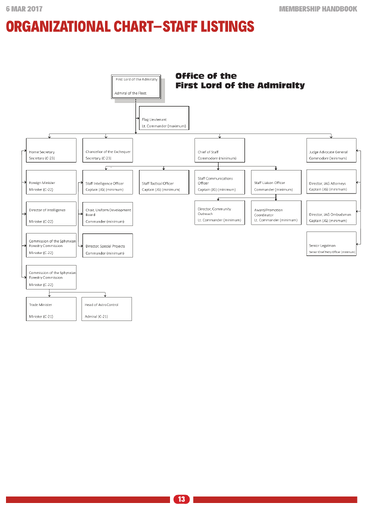 Office of the First Lord of the Admiralty
 -
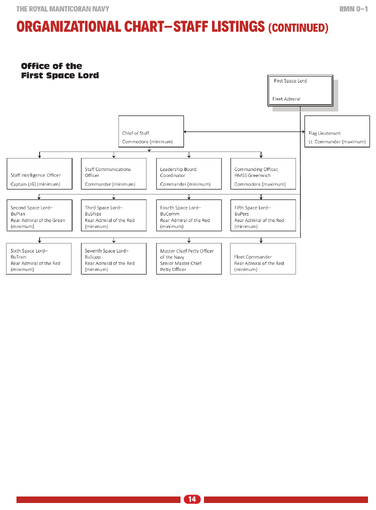 Office of the First Space Lord
 -
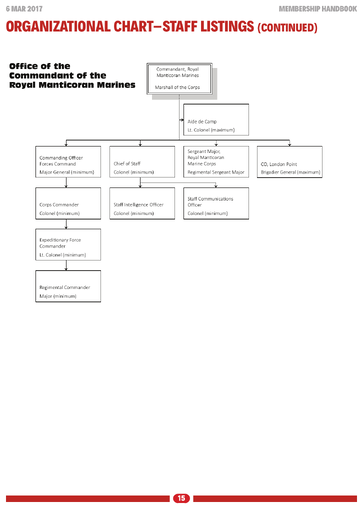 Office of the Commandant of the Royal Manticoran Marine Corps
 -
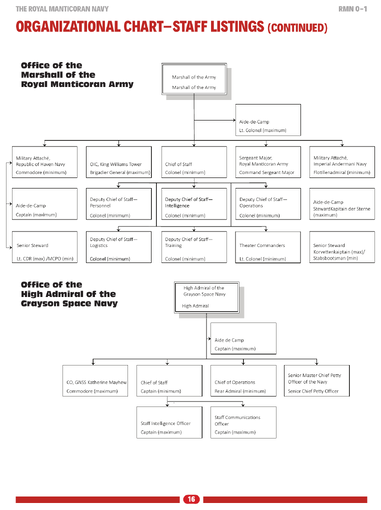 Offices of the Marshal of the Royal Manticoran Army and the High Admiral of the Grayson Space Navy


Membership
| This section was SUPERSEDED by PD-BOD-0010 Membership Policy. Membership eligibility, requirements, and conduct are now governed by the Board's Membership Policy; authority moved from the Royal Council to the Board of Directors and its Disciplinary Committee. The Policy also adds age-18, anti-harassment, anti-hazing, and background-check provisions. See also the new PD-BOD-0011 Youth Policy. |
Membership in TRMN is a privilege extended by the Royal Council which is extended to any eligible person regardless of race, religion, sexuality, gender identity, ethnic background, or any other protected class. There are two exceptions for dual membership (i.e. membership with other groups) covered in the next section. To become a member of TRMN requires the following information:
- Legal name (pseudonyms can be approved by the FLA if a distinct need is shown for them)
- Address, for mailing membership materials
- Email, for our online list-serve, database access, and TRMN forum access
- Division you wish to join (RMN, RMMC, RMA, GSN, IAN, RHN, Civilian)
- A phone number is optional
Since March 2010, membership in TRMN has been, and continues to be, free.
Suspension or Removal of Membership
| This section was SUPERSEDED by PD-BOD-0007 Disciplinary Committee and PD-BOD-0008 Disciplinary Appeals. The Royal Council's discretionary suspension power is replaced by a formal Disciplinary Committee with a due-process complaint procedure and a Board-level appeals path. |
The Royal Council reserves the right to suspend or deny membership to any person for any cause it deems just. This includes, but is not limited to; commission of a crime, being placed on probation or parole, violations of admiralty orders, dangerous behavior to other members or non-members, or actively and knowingly working to damage TRMN financially, physically, or by reputation. The Royal Council reserves the right to tailor suspensions or denials to the circumstances presented, and issue suspensions or denials it feels appropriate given the particulars of any complaint in front of it.
Dual Membership
The information in this section can be found in relevant admiralty orders. TRMN does not discourage membership with other science fiction fan groups. This holds true for every group unless: 1.
The group is openly hostile toward the RMN/RMMC/RMA/GSN/IAN/RHN/CIV. In this case, we will ask that you choose which you prefer to be a member of. We do not need disruptive elements destroying the fun of being with friends we have beyond our computers. a. “Openly hostile” is defined as any action which is directly detrimental to TRMN via words, actions, or any media. b. “Openly hostile” is further defined as any action which violates any of the legal rights TRMN maintains over its property. c. The FSL shall be the final authority in determining if a group falls into the category of “openly hostile” but shall consult with the staff intelligence officer and staff communications officer. 2. A member shares any of the documents listed in the Official Secrets Act,in which case they will be removed from membership of the RMN/RMMC/RMA/GSN/IAH/RHN/CIV in favor of their other group. With these two exceptions, there are no restrictions to membership with the RMN/RMMC/RMA/GSN/IAN/RHN/CIV. An age restriction on command level positions can be found in the relevant admiralty orders. Admiralty orders can be found at http://wiki.trmn.org/wiki/index.php/Admiralty_Orders TRMN reserves the right to deny membership to any person found to have violated the above regulations
The Official Secrets Act
The information in this section can also be found in relevant admiralty orders. The following documents and databases are to be considered classified Royal Manticoran Navy/Marine Corps/Army items and are not to be spread to members without rights to view them. 1.
2.
3. 4. 5. 6. 7.
The online membership database–Only the Royal Council and BuComm database staff will have full access to this database. The admiralty will have access based upon their needs. Fleet, echelon and unit commanders will get access to perform their duties. Certain staff, such as the staffs of BuPers, BuTrain, and the JAG, will also be given access to the database as dictated by their needs. All members will have access to view their own information. The TRMN forums–Only the Royal Council, the space lords, and their designees will have full access to the TRMN forums. All others will have access based on their needs, and all members will have access to view, post, and reply to threads they are members of, and view posts in all public threads. Financial documentation–Only the FLA, the chancellor of the exchequer, and the Seventh Space Lord, and as necessitated by legal requirements, the JAG, shall have access to this information. All exams are controlled items and are covered by the secrets act. Completed answers or exams are not to be shared with any member who has not successfully completed that exam. Any additional documents relating to membership records or member finances deemed to require extra protection to ensure the safety of our membership’s personal and financial information Any documents provided TRMN by BuNine, Words of Weber, or David Weber’s representatives, and deemed as covered by the FLA and FSL. Any additional documents or systems voted on by the admiralty (FLA & the Seven Space Lords), the commandant of the RMMC, the marshal of the RMA, and the high admiral of the GSN. A vote of 8 out of 11 will be required to add a document or system to the Official Secrets Act.
Dissemination of any documents, databases or systems covered by the Official Secrets Act is ground for immediate membership termination.
The Membership “Packet”
Here is a short description of everything you will get in the initial membership email:
- Welcome emails–A series of emails will be sent welcoming you to the organization and your local chapter (as applicable).
- ID cards–These are mailed when run as a batch. Beginning in January 2017, these will be run quarterly. Frequency can be changed as determined by the needs of the organization. Not included:
- Forms, membership handbook, admiralty orders, application to Saganami Island Academy, a berthing registry, and electronic copies of past issues of A Manticore’s Tale, our newsletter, will be found on our website. This list of items may grow as time passes and our ability to offer more grows. Memberships that were signed up at conventions might include additional freebies as those are more visible packets, although those freebies will most likely be from the convention itself.
ID Card Codes
The following codes are used on the ID cards for TRMN. There are two sets of codes, one for rank and one for peerage.
Rank Codes
- C–Civilian (May have six subsets, ie. C-MIN, C-MM, C-CD, C-IS, C-AC, C-SFC, C-SS, C-PLS)
- MIN–Ministerial
- MM–Merchant Marines
- CD–Diplomatic Corps
- IS–Intelligence Staff
- AC–Astro Control
- SFC–Sphinxian Forestry Commission
- SS–Steading Staff
- PLS–Peerage Lands Staff
- E–Enlisted
- W–Warrant Officer
- O–Officer
- F–Flag Officer
Peerage Codes
- G–Grand Duke/Grand Duchess
- D–Duke/Duchess
- S–Steadholder
- C–Earl/Countess
- B–Baron/Baroness
- K–Knight/Dame
Set Up and Organization of Naval Districts / Expeditionary Forces / Theater Commands
| This section was SUPERSEDED by Orders:PD-SC-1003 Chapter and Echelon Policy (issued 29 July 2024 by the Grand Alliance Joint Chiefs of Staff). The structure of naval districts, expeditionary forces, and theater commands is now defined by the Chapter and Echelon Policy, which sets the echelon tiers, minimum command numbers, and geographic regions (see its Echelon Breakdown table). |
A naval district of TRMN is an administrative sub-unit of the main organization. They exist to provide the headquarters function, an ability to more effectively support local units. Because these are official parts of the organization, the naval district commander is a direct local representative of the headquarters. As such, they are afforded the use of the tax identification number to assist in booking events for the district. This would be coordinated through the offices of BuPlan and the FSL. The RMMC equivalent is an expeditionary force. The RMA equivalent is a theater command. Their command structures will dictate reporting in those subgroups.
Royal Manticoran Navy
The Royal Manticoran Navy is divided administratively into the following naval districts: District First Naval District
Fleet Number First Fleet
Fleet Name Home Fleet
Second Naval District Third Naval District
Second Fleet Third Fleet
Gryphon Fleet San Martino Fleet
Fourth Naval District Sixth Naval District Eighth Naval District Ninth Naval District Tenth Naval District Eleventh Naval District
Fourth Fleet Sixth Fleet Eighth Fleet Ninth Fleet Tenth Fleet Eleventh Fleet
Grayson Home Fleet Sphinx Fleet Basilisk Fleet Pending Talbot Fleet Pending
Fleet Composition MD, DE, PA, MA, CT, RI, NY, NJ, NH, VT, ME, DC (includes the greater DC Metro Area), & Northern VA* MN, WI, IL, IN, OH, KY, & MI Southern VA*, WV, NC, SC, MS, AL, TN, GA, FL & the Caribbean, Mexico, and Latin America United Kingdom OK, TX, AR, LA, NE, KS, MO, IA, ND, & SD AZ, NM, UT, CO, WY, & MT Held for Future Use CA, OR, WA, NV, ID, & HI Held for Future Use
Station Anzus Andermani Victoria Sidemore
Former Fleet # Fifth Fleet Seventh Fleet None None
Station Name Anzus Station Andermani Station Victoria Station Sidemore Station
Station Composition Oceania, Australia & New Zealand Central Europe AK, BC, YT, NT, NU, SK, & AB QC, ON, PE, NL, NS, MB, & NB
Allied Fleet Andermani
Fleet Number Seventh Fleet
Republic of Haven
Twelfth Fleet
Fleet Name Fleet Composition The Imperial Andermani Held for Future Use Expeditionary Fleet The Haven Held for Future Use Expeditionary Fleet
- The division line between the 1st and 3rd Naval Districts in Virginia will be the 38th Parallel.
Victoria Station will be part of Tenth Fleet, and the station commander will report to the Tenth Fleet commanding officer. Sidemore Station will be part of First Fleet, and the station commander will report to the First Fleet Commanding Officer.
Royal Manticoran Marine Corps
The RMMC is administratively divided into corps, expeditionary forces, regiments, and then smaller units. Below is the current break down of the RMMC’s corps and expeditionary forces: Corps: The RMMC is divided in to three different corps. These corps encompass several geographical regions of the globe. These may be changed as necessary by the issuance of a corps directive. 1. First Corps–London Point, North & South America 2. Second Corps–Europe & Africa 3. Third Corps–Asia & Australia
Expeditionary Forces TRMN is divided administratively into geographic regions of the globe. In the RMN, these are known as “naval districts”. In the RMMC, these are known “expeditionary forces.” Below is the breakdown of the expeditionary forces currently in the RMMC. These may be changed as necessary by the issuance of a corps directive.
- First Expeditionary Force (First Fleet and Sidemore Station):
- MD, DE, PA, MA, CT, RI, NY, NJ, NH, VT, ME, DC (includes the greater DC Metro Area), & Northern VA*–First Fleet
- QC, ON, PE, NL, NS, MB, & NB–Sidemore Station
- Second Expeditionary Force (Second Fleet):
- MN, WI, IL, IN, OH, KY, & MI
- Third Expeditionary Force (Third Fleet):
- Southern VA*, WV, NC, SC, MS, AL, TN, GA, FL & the Caribbean, Mexico and Latin American
- Fourth Expeditionary Force (Fourth Fleet):
- United Kingdom
- Fifth Expeditionary Force (Anzus Station):
- Oceania, Australia & New Zealand
- Sixth Expeditionary Force (Sixth Fleet):
- OK, TX, AR, LA, NE, KS, MO, IA, ND, & SD
- Seventh Expeditionary Force (7th Fleet and Andermani Station):
- Central Europe
- Eighth Expeditionary Force (Eighth Fleet):
- AZ, NM, UT, CO, WY, & MT
- Ninth Expeditionary Force (Ninth Fleet):
- Research and Development. No active MARDETs
- Tenth Expeditionary Force (Tenth Fleet and Victoria Station):
- CA, OR, WA, NV, ID, & HI–Tenth Fleet
- AK, BC, YT, NT, NU, SK, & AB–Victoria Station
- Eleventh Expeditionary Force (Eleventh Fleet):
- Composition pending future activation.
- Twelfth Expeditionary Force (Twelfth Fleet):
- Composition pending future activation. *The division line between the 1st and 3rd Fleet/Expeditionary Force in Virginia will be the 38th Parallel
Regiments The next level in the RMMC organization is the regiment. In the RMMC, regiments are a grouping of smaller units within a specific geographical area. Regiments in the RMMC are not numbered, but are named. Below is a listing of the standing regiments in the RMMC. Other regiments may be added or removed as necessary. 1. First Corps, First Expeditionary Force–“The Manticore Guard Regiment” aka Manticore Guards 2. First Corps, Second Expeditionary Force–“The Gryphon Highlander Regiment” aka Gryphon Highlanders 3. First Corps, Third Expeditionary Force–“The Montanero Regiment” 4. First Corps, Fourth Expeditionary Force–“The New Covenant Regiment” 5. First Corps, Sixth Expeditionary Force–“Tannerman Rifle Regiment” aka Tannerman Rifles 6. First Corps, Eighth Expeditionary Force–“The Medusa Regiment” 7. First Corps, Tenth Expeditionary Force–“The Lynx Regiment” 8. Second Corps, Seventh Expeditionary Force–“The Gregor Regiment” 9. Third Corps, Fifth Expeditionary Force–“Royal Adrianne’s Regiment” 10. Fourth Corps, Torch Fleet–“The Amistad Regiment”
Royal Manticoran Army
The RMA consists of the following theater/battle group commands: 1.
Home System–North & South America
2. Manticore Planetary Command–United States 3. Sphinx Planetary Command–Canada 4. Gryphon Planetary Command–Mexico & South America 5. Trevor’s Star–Europe & Africa 6. San Martin Planetary Command–Europe 7. *VI Planetary Command–Africa 8. Talbot Quadrant–Asia & Australia 9. V Planetary Command–Australia 10. *VII Planetary Command–Asia * Currently inactive
This can be expanded as needed. It is up to the naval district commander to ensure that all the chapters in their district are receiving the support they need. They will be supported by the space lords as needed as well. The district commanders are appointed by, and report to, the FSL. Expeditionary force commanders are appointed, and report to, the Commandant of the Corps. Theater commanders are appointed by, and report to, the Marshal of the RMA.
Chapter Formation and Regulations
| This section was SUPERSEDED by Orders:PD-SC-1003 Chapter and Echelon Policy (issued 29 July 2024 by the Grand Alliance Joint Chiefs of Staff). Chapter formation requirements, minimum numbers, and disbandment are now governed by the Chapter and Echelon Policy. |
This section deals with what is required to form a RMN chapter. For RMMC units, please consult the following Corps Directives: CD 02-1302, CD 05-1308, CD 04-1302, and any other corps directive (CD) pertaining to RMMC unit policies and procedures. For RMA units, please consult The Soldier’s Guide, RMASM-101. For the RMN, this section will cover minimums for basic chapters based on a sample. For more specific information, those wishing to create a chapter should reference the Commanding Officer’s Manual, RMN-3-002, and the relevant admiralty orders which deal with chapter membership for type as well as the Commanding Officer’s Manual, RMN-3-002, for detailed information. For the purposes of this section, we will use the example that the chapter being set up is a destroyer (DD). Chapters are “associated units” with TRMN. As such, they will gain the benefits of support from the parent organization as well as access to materials such as recruiting packets and manuals, but they will be separate operating units treated as direct affiliates. If they wish to conduct business as a chapter on behalf of TRMN, they will be required to apply to BuPlan for use of the TRMN’s tax identification number. To set up their own bank account, however, a chapter will need to acquire their own tax identification number. The first step in setting up a chapter will be to assemble your crew. In this case, you will need a minimum of six people. Of those six, at least two must be officers and at least one of those must have completed the lieutenant commander’s exam. Those two officers will be the commanding officer (CO) and executive officer(XO). Of the enlisted personnel, at least one must have completed the chief petty officer exam. These people should be listed on the chapter launch request form. On that form, they should list the membership information of all chapter members, including academy courses and date of rank. This is then sent to the regional commander. The regional commander then signs off on adding the new DD to his fleet. At this point, the paperwork is passed on to the Third Space Lord, who approves the chapter and commissions the new DD into its fleet. A chapter must have, at a minimum, the following: 1. Commanding officer 2. Executive officer, who must have completed the same training as the commanding officer 3. Chief petty officer (bosun) A correspondence chapter has the same requirements as a meeting chapter, except that a correspondence meeting may not convene independently more than twice a year. This means having face-to-face meetings not connected with a convention or other event. A meeting chapter must convene a minimum of three times per year. The minimum age for a commanding officer of a chapter is 18 years old, except where state or national law has a higher age of majority, in which case that age shall be the minimum for that state or country. These age restrictions also apply to the executive officer and the chief petty officer. These ages are put in place for liability issues. As the commanding officer is responsible for the conduct of this chapter, they must be able to be legally responsible. If a chapter holds meetings, the commanding officer is responsible for securing a safe location. This location may be public but must also be safe. If the meetings are held after dark, then the commanding officer must make sure that all the members leave safely.
Disbanding a Chapter
Should a chapter choose to leave TRMN, it must send a certified letter to the FSL. Once it is confirmed that the letter has been received, a chapter is free to operate independently of the organization. It must at that time, however, cease using TRMN manuals and documentation. When a chapter leaves, each member must also notify BuPers that they wish to leave TRMN. If they do not, they will be kept on the membership roster.
A chapter will also be considered to have left if it gets decommissioned based on the regulations in the Fleet Operations Manual, RMNM-002, or the Commanding Officer’s Manual, RMNM-003. These two can be appealed directly to the FSL and FLA who, in conference with BuShips, may authorize an exemption for a limited time.
Manticore Military and Civil Service Academies
Current training academies, curricula, and qualification requirements are maintained by the Bureau of Training (BuTrain); see Portal:Education.
The Royal Manticoran Naval Academy at Saganami Island is where TRMN has our training courses. In addition, there are the King Roger I Military Academy for RMA training, the Isiah MacKenzie Naval Academy for GSN, and Landing University for civilian schools. For the RMN and RMMC, these training courses fall into one of three primary schools.
Enlisted Training Schools
The enlisted academy is a basic introduction to the Honorverse as well as a basic introduction to TRMN. The enlisted academy is divided into three sections: basic enlisted, noncom, and technical specialties. The basic section is designed to be a true introductory course. All members, upon joining, are required to take the E-1 basic course. This simple course gives you a good introduction to the Honorverse. The noncom section is designed to begin your training as a leader and manager. It will introduce, in very broad terms, some basic leadership concepts and management ideas. The technical specialties section is designed to help you learn more about your various shipboard divisions and systems. These courses are recommended for both enlisted and officers as they will help you understand your division better.
Warrant Officers Academy
The warrant program is designed to advance senior noncoms who deserve and have earned the chance for more command responsibility. It also furthers the leadership advanced by the noncom section of the enlisted academy.
Officers Academy
The officers academy is subdivided into four schools. These will teach leadership, management, and tactics. The field officers school trains the first three levels of officer. These courses focus on basic management and leadership. In addition to this, there is a management course which serves as an introduction to the next school. The staff officer school trains the next three levels of officer. These courses focus on more advanced management and leadership techniques. In the near future, there will also be courses on tactics introduced at this level. The Saganami War college trains the flag officers, including the captain of the list. These courses focus directly on advanced management, leadership, and tactics. The Saganami Island Tactical Simulator is the final school in the officers academy and is part of the Saganami War College. It is designed with the sole intent of teaching tactics and as such is open to every commanding and executive officer of destroyers (DD) and above.
Ranks
| This section was SUPERSEDED by Orders:PD-SC-1004 Rank and Promotion Policy (enacted by Orders:Joint Chiefs Directive 2311-01). The rank tracks are now published in PD-SC-1004; a civilian grade scale (e.g. the Home Secretary's C-grades) and the added Imperial Andermani and Havenite navies also fall outside this table. |
The following are the ranks for the RMN, GSN, RMMC, and RMA. The IAN and RHN ranks can be found here.
| Rank | Royal Manticoran Navy | Grayson Space Navy | Royal Manticoran Marines / Army |
|---|---|---|---|
| E-1 | Spacer 3rd Class | Spacer 3rd Class | Private |
| E-2 | Spacer 2nd Class | Spacer 2nd Class | Private First Class |
| E-3 | Spacer 1st Class | Spacer 1st Class | Lance Corporal |
| E-4 | Petty Officer 3rd Class | Petty Officer 3rd Class | Corporal |
| E-5 | Petty Officer 2nd Class | Petty Officer 2nd Class | (Platoon) Sergeant |
| E-6 | Petty Officer 1st Class | Petty Officer 1st Class | Staff Sergeant |
| E-7 | Chief Petty Officer | Chief Petty Officer | First Sergeant |
| E-8 | Senior Chief Petty Officer | Senior Chief Petty Officer | Master Sergeant |
| E-9 | Master Chief Petty Officer | Master Chief Petty Officer | Sergeant Major |
| E-10 | Senior Master Chief Petty Officer | Senior Master Chief Petty Officer | Regimental Sergeant Major |
| WO-1 | Warrant Officer 2nd Class | Warrant Officer 2nd Class | Warrant Officer 2nd Class |
| WO-2 | Warrant Officer 1st Class | Warrant Officer 1st Class | Warrant Officer 1st Class |
| WO-3 | Chief Warrant Officer | Chief Warrant Officer | Chief Warrant Officer |
| WO-4 | Senior Chief Warrant Officer | Senior Chief Warrant Officer | Senior Chief Warrant Officer |
| WO-5 | Master Chief Warrant Officer | Master Chief Warrant Officer | Master Chief Warrant Officer |
| O-1 | Ensign | Ensign | Second Lieutenant |
| O-2 | Lieutenant (Junior Grade) | Lieutenant (Junior Grade) | First Lieutenant |
| O-3 | Lieutenant (Senior Grade) | Lieutenant (Senior Grade) | Captain |
| O-4 | Lt. Commander | Lt. Commander | Major |
| O-5 | Commander | Commander | Lieutenant Colonel |
| O-6-A | Captain (Junior Grade) | Captain (Junior Grade) | Colonel |
| O-6-B | Captain of the List | Captain of the List | Colonel of the List |
| F-1 | Commodore | Commodore | Brigadier General |
| F-2 | Rear Admiral | Rear Admiral | Major General |
| F-3 | Vice Admiral | Vice Admiral | Lieutenant General |
| F-4 | Admiral | Admiral | General |
| F-5 | Fleet Admiral | Fleet Admiral | Marshall |
| F-6 | Admiral of the Fleet | High Admiral | Marshall of the Corps/Army |
Promotion Policies are also outlined in Orders:Admiralty Order 1701-01.
Promotion Policies
| This section was SUPERSEDED by Orders:PD-SC-1004 Rank and Promotion Policy and Orders:PD-SC-1008 Promotion Board Policy (enacted by Orders:Joint Chiefs Directive 2311-01 and Orders:Joint Chiefs Directive 2312-03). Promotion criteria and board composition are now set by the PD-SC policy series; flag-officer promotions are boarded by the Steering Committee (Orders:Joint Chiefs Directive 2406-01), not chaired by the First Lord of the Admiralty. The Admiralty Order 1701-01 referenced below is itself superseded. |
ENLISTED Enlisted promotions, up through the rank of chief petty officer (E-7), are handled by your commanding officer. The E-7 promotions, after consultation with the senior chief petty officer of the Navy (RMN), senior chief petty officer of the Grayson Navy (GSN), and sergeant major of the Army (RMA) to ensure appropriateness of the selected candidate, as per Naval Directive 15SE-02. These promotions are still required to meet the criteria and requirements for promotion laid out in Admiralty Order 1701-01. Regular audits will be performed on all E-7 promotions by BuPers at least once every six months. Any individuals failing to meet the requirements during an audit will be reverted to their original rank. Promotions to senior chief petty officer (E-8), master chief petty officer (E-9), and senior master chief petty officer (E-10) [plus E-11 for the RMA] are done by written recommendation of the commanding officer, plus the candidate’s academic record and time in grade (TIG) verification submitted to the enlisted promotion board who will either approve or not approve the promotion. Saganami Island Academy may promote enlisted personnel up to and including the rank of SMCPO, within the guidelines established for promotion of those personnel who, due to location, are unable to join a “meeting crew” and recommend the academic ribbons earned.
WARRANT OFFICER After the initial Monarch’s Warrant is awarded, further warrant promotions are done by written recommendation of the commanding officer, plus the candidate’s academic record and TIG verification submitted to the FLA, who will make the final decision concerning the promotion.
OFFICER After the commission as ensign, commanding officer’s may submit to their fleet commander to promote a member of their crew up to lieutenant junior grade without submitting to a board. These promotions are still required to meet the criteria and requirements for promotion laid out in Admiralty Order 1701-01. Regular audits will be performed on all lieutenant junior grade promotions by BuPers at least once every six months. Any individuals failing to meet the requirements during an audit will be reverted to their original rank. All other officer promotions through captain junior grade are done by written recommendation of the commanding officer, plus academic record and Time in Grade (TIG) verification submitted to the Officer Promotion Board, who will either approve or not approve the promotion.
FLAG OFFICER Promotion to captain of the list is done by written recommendation of a member of the admiralty, plus academic record and TIG verification submitted to the Flag Promotion Board, who will either approve or not approve the promotion. Promotion to commodore may occur after the minimum TIG has been met. Promotion to rear admiral of the red may occur after the minimum TIG and the appropriate War College Course has been passed. Promotion to vice admiral of the red and up is done by written recommendation of a member of the admiralty, plus academic record and TIG verification submitted to the Flag Promotion Board who will either approve or not approve the promotion.
CIVILIAN Promotions within the civilian ranks are handled a little differently. There are currently two main civilian tracks: espionage or ambassadorial. Four more civilian ranks fall under the umbrellas of the two main tracks, or, in some cases, be a track of their own. Civilian promotions up to consul do not necessarily require a billet. Once that point has been reached, however, an actual opening must exist and need to be filled for a civilian to be promoted. TIG is not required for civilians, although there are recommendations for TIG. However, after Consul, a recommendation from a superior is required. The Civilian Review Board will handle all civilian promotions.
Promotions Boards
ENLISTED PROMOTIONS BOARD The Enlisted Promotions Board convenes for enlisted promotions for senior chief petty officer, master chief petty officer and senior master chief petty officer. A commanding officer may issue a brevet promotion to chief petty officer but it may be audited by this promotions board at its next sitting if questions arise. The Enlisted Promotions Board will meet every other month starting in February. This meeting can be conducted either via online means or via phone. A special Enlisted Promotions Board will be convened once a year. Please see the special promotions boards section. The composition of the Enlisted Promotions Board will be as follows:
- Chair–senior master chief petty officer of the RMN
- Admiralty Member–FLA
- Senior Fleet/Corps/Army Commander–This is the commander of the fleet/corps/army in which the enlisted member is assigned (if more than one branch has promotion eligible members, all relevant personnel will be present).
- Senior Noncommissioned Member–The senior noncommissioned member of the appropriate branch will be invited to participate.
- Junior Officer–A lieutenant senior grade or lower not in the chain of command above the enlisted member(s) up for promotion.
- Junior Enlisted Member–An enlisted member between petty officer 3rd class and chief petty officer not in the chain of command beneath the enlisted member(s) up for promotion The board should always consist of an odd number of members. If enough branches are represented to make the number of members even, one branch will be included in the next cycle. A vote to confirm a promotion must always be a majority vote (e.g. 2 to 1). Should a vote not confirm a promotion, the enlisted candidate must wait three quarters to resubmit.
WARRANT PROMOTIONS The Warrant Promotions Board convenes for all warrant officer promotions. It does not issue original warrants. Those are issued by the FLA. The Warrant Promotions Board will meet the first month of every quarter starting with January. This meeting can be conducted either via online means or via phone. A Special Warrant Promotions Board will be convened once a year. Please see the Special Promotions Boards section. The composition of the Warrant Promotions Board will be as follows:
- Chair–chief of staff of the FLA
- Admiralty Members–FLA and Fifth Space Lord (BuPers)
- Senior Fleet/Corps/Army Commander–This is the commander of the fleet/corps/army in which the member is assigned (If more than one branch has promotion eligible members, all relevant personnel will be present).
- Senior Officer–A lieutenant commander up through captain junior grade of the appropriate branch will be invited to participate.
- Junior Officer–A lieutenant senior grade or lower not in the chain of command above the member(s) up for promotion
- Second Junior Officer–A warrant officer if possible; if not, a second lieutenant senior grade or lower not in the chain of command above the member(s) up for promotion The board should always consist of an odd number of members. If enough branches are represented to make the number of members even, one branch will be included in the next cycle. A vote to confirm a promotion must always be a majority vote (e.g. 2 to 1). Should a vote not confirm a promotion, the candidate must wait two quarters to resubmit.
OFFICER ONE PROMOTION BOARD The Officer One Promotions Board convenes for all promotions for lieutenant senior grade and lieutenant commanders. The Officer One Promotions Board will meet every other month starting in February. This meeting can be conducted either via online means or via phone. A special Officer Promotions Board will be convened once a year. Please see the special promotions boards section. The composition of the Officer One Promotions Board will be as follows:
- Chair–Fifth Space Lord (BuPers) or their designee
- Admiralty Members–FLA, Second Space Lord (BuPlan) and Fifth Space Lord (BuPers) (Only if designee used to chair).
- Senior Fleet/Corps/Army Commander–This is the commander of the fleet/corps/army in which the member is assigned (If more than one branch has promotion eligible members, all relevant personnel will be present).
- Senior Officer–A lieutenant commander up through captain junior grade of the appropriate branch will be invited to participate.
- Junior Officer–A lieutenant senior grade or lower not in the chain of command above the officer(s) up for promotion.
- Second Junior Officer–A lieutenant junior grade or lower not in the chain of command above the officer(s) up for promotion The board should always consist of an odd number of members. If enough branches are represented to make the number of members even, one branch will be included in the next cycle. A vote to confirm a promotion must always be a majority vote (e.g. 2 to 1). Should a vote not confirm a promotion, the candidate must wait three quarters to resubmit.
OFFICER TWO PROMOTION BOARD The Officer Two Promotions Board convenes for all promotions for commander and captain junior grade. The Officer Two Promotions Board will meet every other month starting in January. This meeting can be conducted either via online means or via phone. A special officer promotions board will be convened once a year. Please see the special promotions boards section. The composition of the Officer Two Promotions Board will be as follows:
- Chair–Fifth Space Lord (BuPers) or their designee
- Admiralty Members–FLA, Third Space Lord (BuShips) and Sixth Space Lord (BuTrain)
- Senior Fleet/Corps/Army Commander–This is the commander of the fleet/corps/army in which the member is assigned (If more than one branch has promotion eligible members, all relevant personnel will be present).
- Senior Officer–A lieutenant commander up through captain junior grade of the appropriate branch will be invited to participate.
- Junior Officer–A lieutenant senior grade or lower not in the chain of command above the officer(s) up for promotion
- Second Junior Officer–A second lieutenant senior grade or lower not in the chain of command above the officer(s) up for promotion
The board should always consist of an odd number of members. If enough branches are represented to make the number of members even, one branch will be included in the next cycle. A vote to confirm a promotion must always be a majority vote (e.g. 2 to 1). Should a vote not confirm a promotion, the candidate must wait three quarters to resubmit.
FLAG PROMOTION BOARD A flag promotions board shall be convened for every flag promotion of rear admiral and higher. The Flag Officer Promotions Board will meet every other quarter starting in April. This meeting can be conducted either via online means or via phone. A special officer promotions board will be convened once a year. Please see the Special Promotions Boards section. The composition of the Flag Officer Promotions Board will be as follows:
- Chair–chief of staff for the FLA
- Admiralty Member–FLA
- Branch Commanders (Quarter 2)–FSL and marshal of the RMMC
- Branch Commanders (Quarter 4)–high admiral of the GSN and marshal of the RMA
- Senior Fleet/Corps/Army Commander–This is the commander of the fleet/corps/army in which the member is assigned (If more than one branch has promotion eligible members, all relevant personnel will be present).
- Senior Officer–A rear admiral of the green up through admiral of the red of the appropriate branch will be invited to participate. This person *must* hold a command of their own.
- Officer–A captain junior grade up through commodore not in the chain of command above the officer(s) up for promotion. This person may have held a command of their own, or served as a staff officer.
- Junior Officer–A second captain junior grade up through commodore not in the chain of command above the officer(s) up for promotion. The board should always consist of an odd number of members. If enough branches are represented to make the number of members even, one branch will be included in the next cycle. A vote to confirm a promotion must always be a majority vote (e.g. 2 to 1). Should a vote not confirm a promotion, the candidate must wait three quarters to resubmit to the civil service review board.
CIVIL SERVICE REVIEW BOARD A civil service review board shall be convened for every civilian promotion above administrator, which is not a billet promotion. The civil service review board will meet during the second month of each quarter starting in February. This meeting can be conducted either online or via phone and applications should be submitted to the chief of staff for the FLA. A special review board will be convened once a year. Please see the Special Promotions Boards section. The composition of a civil service review board will be as follows:
- Chair–FLA
- Branch Commander–FSL
- Senior Civilian–This is a civilian of C-13 or above who is not in the chain of command of the civilian up for promotion. Preferably they should be of the same track as the candidate.
- Civilian–This is a civilian equal to or greater than the civilian up for promotion. They should not be in the chain of command of the civilian up for promotion. Preferably they should be of the opposite track as the candidate.
- Civilian–This is a civilian equal to or lower than the civilian up for promotion. They should not be in the chain of command of the civilian up for promotion. Preferably they should be of the same track as the candidate.
- Non-Voting Member–The Judge Advocate General or designee. The board should always consist of an odd number. A vote to confirm a promotion must always be a majority vote (e.g. 2 to 1). Should a vote not confirm a promotion, the candidate must wait at least two quarters to resubmit.
SPECIAL CASES A special promotions board will convene the Friday night before the annual conference to consider all promotions submitted to it for that time period. The composition of a special promotions board shall be as follows:
- Chair–Most senior admiral/general present
- Senior Officer–Second most senior admiral/general/officer present
- Junior Member–A junior officer or enlisted member The board should always consist of an odd number. For Civil Service promotions, a civilian should, when possible, replace the junior member. A vote to confirm a promotion must always be a majority vote (e.g. 2 to 1). Should a vote not confirm a promotion, the candidate’s promotion may be resubmitted in time for the next regularly constituted promotions board.
The “Missing Man” Rule
Should a person of appropriate rank not be found, the FLA may pick a replacement of any rank based on availability. As the organization grows, the need for this rule to be invoked should decrease.
Promotion Criteria
NORMAL To be eligible for promotion, whether via board review or, for the lower enlisted ranks, promotion by commanding officer, the candidate must have the following:
- The required time in grade
- A score of at least 70 percent on the qualifying exam
- A minimum combined criteria weight of 80 percent
- A billet must exist for:
- Enlisted members being promoted to chief petty officer or higher
- Warrant officers being promoted to chief warrant officer or higher
- Officers being promoted to lieutenant senior grade or higher The weight of each will be as follows:
- Time in Grade–25 percent
- Qualifying Exam:
- 70 percent on Exam–20 percent
- 80 percent on Exam–30 percent
- 90 percent on Exam–40 percent
- 100 percent on Exam–50 percent
- Commanding officer’s recommendation:
- Negative recommendation, but application submitted–5 percent
- Neutral recommendation–20 percent
- Good recommendation–25 percent
- Excellent recommendation–35 percent
- If SWP or branch equivalent complete–10 percent Using this scale, it is possible to get promoted with either a 70 percent or a negative recommendation, but such a promotion requires time in grade and a 100 percent score on the qualifying exam.
To be eligible for civilian promotion via board review, the candidate must have the following:
- A majority (at least 75 percent) of the recommended time in grade
- A score of at least 70 percent on the qualifying civil service exam
- A minimum combined criteria weight of 80 percent
- A position:
- Must exist for a civilian being promoted to C-13 or higher
- Should exist for a civilian being promoted to C-5 or higher The weight of each will be as follows:
- Time in Grade:
- 75 percent of TIG–15 percent
- 90 percent of TIG–20 percent
- 100 percent of TIG–25 percent
- Qualifying Exam:
- 70 percent on Exam–20 percent
- 80 percent on Exam–30 percent
- 90 percent on Exam–40 percent
- 100 percent on Exam–50 percent
- Supervisors Recommendation:
- Negative recommendation, but application submitted–5 percent
- Neutral recommendation–15 percent
- Good recommendation–20 percent
- Excellent recommendation–30 percent Using this scale, it is possible to get promoted with either a 70 percent or a negative recommendation, but such a promotion requires time in grade and a 100 percent score on the qualifying exam
SPECIAL To be eligible for special promotion, whether via board review or, for the lower enlisted ranks, promotion by commanding officer, the candidate must have the following:
- Be no more than half way outside the time in grade window
- A score of at least 90 percent on the qualifying exam
- A minimum combined criteria weight of 90 percent
- A billet must exist for:
- enlisted members being promoted to chief petty officer or higher
- Warrant officers being promoted to chief warrant 0fficer or higher
- Officers being promoted to lieutenant senior grade or higher The weight of each will be as follows:
- Time in Grade–25 percent minus 2 percent for each month outside the window for enlisted members and minus 5 percent for each month outside the window for warrant officers and officers.
- Qualifying Exam:
- 90 percent on exam–40 percent
- 100 percent on exam–50 percent
- Commanding Officer’s Recommendation:
- Negative recommendation, but application submitted– 5 percent
- Neutral recommendation–15 percent
- Good recommendation–30 percent
- Excellent recommendation–40 percent
Billet Assignment
In the rare event that any member is promoted due to the billet they are assigned to (e.g. admiral of the red for Seventh Space Lord or rear admiral of the red for commander home fleet) they *MUST* have completed all their required courses for that level. If the candidate has not completed his/her courses prior to promotion, he/she will remain at their current rank. If the candidate subsequently completes their courses, they may apply to have their appropriate billet rank instated. This will be solely at the discretion of the appointing officer. The JAG or JAG-ombudsman will verify the records of the candidate for promotion and, based on the records, TIG and billet (if applicable), provide a positive or negative recommendation to the members of the board.
Submission Deadlines
These are the deadlines for the receipt of promotion request. They can be received before these times, but no later. Enlisted–One month prior to the promotion board convening Warrant–The last month of the preceding quarter of the promotion board convening. Officer One–One month prior to the promotion board convening Officer Two–One month prior to the promotion board convening Officer Three–Second month of the preceding quarter of the promotion board convening. Flag–Second month of the preceding quarter to the promotion board convening. Civilian–One month prior to the promotion board convening Special–Two weeks prior to an event where the promotion will be given
Reporting Criteria
Once a board has been held, the convening officer or designee has one week to inform BuPers unless a promotion is to be handed out at a TRMN-run convention or if it has been requested to be kept confidential by the fleet commander or branch equivalent. In such cases, the information is still to be sent to BuPers within one week, but an effective date is to be included, and BuPers is not to enter the promotion into the database before that date.
Demotion
Once a rank is awarded, only a gross violation of another member’s rights or violation of an admiralty order will cause demotion. A promotion panel will meet and a vote of three to two will confirm the demotion. This is only to be used in the most extreme cases. A promotion panel convened for the purpose of demotion must contain five members in good standing. The exception for a demotion is a reduction to previously earned rank due to not taking or demonstrating a good faith effort in taking tests. These reductions may be done by the First Space Lord for RMN personnel, the Commandant of the Corps for RMMC personnel, the Marshal of the Army for RMA, IAN & RHN personnel, the High Admiral of the GSN for GSN personnel, and the FLA for civilian personnel. A request by a member to demote them will also be considered. Such requests must come in writing and contain an explanation for the request. The FLA, together with the JAG and the senior JAG ombudsman, will make a final decision on if this is to be accepted on a case-by-case basis.
Peerage
| This section was AMENDED by Orders:PD-SC-1009 Peerage Nomination and Elevation Policy (enacted by Orders:Joint Chiefs Directive 2312-02) and PD-BOD-0006 Steering Committee. The peerage mechanics below largely stand, but nominations are now capped (approximately 1% of membership), the Peerage Board is convened by the Lord Speaker of the House of Lords within the new Parliament, and the Steering Committee sets the annual allotment and gives final approval. |
The RMN, RMMC, and RMA all use peerages a way to recognize people who have not met the TIG requirements for the next rank, yet have demonstrated service above and beyond what their rank requires. This does not give an individual the right of command over any other individual, and is merely a way to honor those who have worked hard. Peerage is defined as a system of titles of nobility in the Star Kingdom of Manticore, part of the Manticoran honors system. The term is used both collectively to refer to the entire body of titles, and individually to refer to a specific title. All Manticoran honors, including peerage dignities, spring from the admiralty, which is considered the fount of honor. The peerage titles, in order of precedence from highest to lowest, are:
- Grand Duke/Grand Duchess–This is primarily reserved for members of the royal family and David Weber’s family, but exceptions can be made for extreme or exceptional service to the organization.
- Duke/Duchess–Steadholder
- Earl/Countess
- Baron/Baroness
- Knight/Dame–This can also be a rank within the peerage system. i.e. Knight Commander of the Order of Roger.
Forms of Address by Peerage
Grand Duke/Grand Duchess:
- Formal address: His/Her Grace the Grand Duke/Grand Duchess of (duchy)
- Informal address: Your Grace (the first time) and Sir or Ma’am every time afterward. If you are a friend, you may use the name of his or her duchy. Close friends and relatives may use first names, but only in non-formal social occasions. Duke/Duchess–Steadholder:
- Formal address: His/Her Grace the Duke/Duchess of (duchy) or His/Her Grace the Steadholder (duchy)
- Informal address: Your Grace (the first time) and Sir or Ma’am every time afterward. If you are a friend, you may use the name of his or her duchy. Close friends and relatives may use first names, but only in non-formal social occasions. Earl/Countess:
- Formal address: The Right Honorable Earl of (county) or the Right Honorable Countess of (county)
- Informal address: Lord (county) or Lady (county)–the first time–and My Lord or My Lady every time afterward. If you are a close friend or relative, you may use simply the name of the county. Baron/Baroness:
- Formal address: The Right Honorable Baron of (barony) or the Right Honorable Baroness of (barony)
- Informal address: Lord (barony) or Lady (barony)–the first time–then My Lord or My Lady. If you are a friend or a relative, you may use simply the name of the barony Knight/Dame:
- Formal address: Sir John Smith, KDR or Dame Jane Smith, KDR. The post-nominal (after the name) letters must always be used, and should be announced in order of precedence, rather than in order of seniority;
- Informal address: Sir John Smith, or Dame Jane Smith
Cadet Seats of a hereditary landed peer:
- Formal address: The Lord John Smith of (holding) or the Lady Jane Smith of (holding)
- Informal address: My Lord or My Lady. Close friends and relatives may use first names. Named peerages follow the same general style and form of address, but remove the “of (land)” in favor of “Last name”. For example, The Right Honorable Baron Smith
Peerage Award
| This section was SUPERSEDED by Orders:PD-SC-1009 Peerage Nomination and Elevation Policy (enacted by Orders:Joint Chiefs Directive 2312-02) and Orders:Joint Chiefs Directive 2406-01. Peerage and knighthood nominations now route through an awards package to the Bureau of Personnel and a Steering Committee vote, awarded twice annually; there are no unilateral grants. |
There are three methods in which to acquire peerage. The first two will be obvious, the third not as much.
- 1st–Admiralty Award. This will be done based upon your rank or rating. The list below will show based on rating and rank the qualification levels for the peerage titles.
- 2nd–Marriage. Following the British tradition, if you are married (in real life), your wife will receive the same privilege and title as you in the opposite gender form. This does not apply to Knights/Dames as that is always a non-landed peerage award. This also does not apply to husbands, who do not acquire honorary peerage through their wife or husband, but will be permitted to be addressed as Lord <land>. Additionally, in the event of a situation where an individual has more than one spouse, only the senior (1st) spouse gets the honorary title. In the event of a same sex union, the spouse will be permitted to be addressed as Lord <land> or lady <Land>
- 3rd–Children. If you have children (in real life,) they will be granted a cadet peerage in your family. They may be referred to by the cadet form of address listed above. This does not apply to Knights/Dames as that is always a non-landed peerage award. Once a peerage has been issued, a further issuance of peerage award will promote you to a higher level. As an example, if you are currently a baron, and receive another peerage, your baron level will increase to that of earl.
Approval
All peerage must be voted on by the Peerage Court. The Peerage Court consists of the FLA and at least three other landed peers. A vote on the peerage must be held and the result must be at least three in favor of approval *before* the title is bestowed upon the recipient. The FLA, as president of the Peerage Court, may bestow non-landed peerages as needed. For grand duke/grand duchess, the court must consist of at least 10 peers, and the vote must be unanimous.
Maximum Peerage Levels available by Royal Manticoran Rank E-4 -> E7 ==> Knight/Dame (As it is non-landed, this is the highest award available for the enlisted ratings. Their TIG is also shorter.) E8 -> O-1 ==> Baron/Baroness O-2 -> O-3 ==> Knight/Dame O-4 -> O-6(A) ==> Baron/Baroness O-6(B) -> F-1 ==> Earl/Countess–Steadholder F2 -> F-6 ==> Duke/Duchess By Appointment Only ==> Grand Duke/Grand Duchess This chart uses military codes. Equivalent civilian levels will be applied for civilians who are nominated.
Non-Landed vs. Landed Peerage
Landed peerage will work through a space on the wall of peerage in the RMN headquarters and in the peerage page of the quarterly newsletter. Additionally, landed peerage will come with the privilege of setting up peerage lands as outlined in that section of this manual. Not all peerages come with land, and a member can have peerage of name as well. As a member’s peerage title increases, he/she will be given a space on the wall of peerage commensurate with the title to place his/her coat of arms, which the member will be given certain rights to design him or herself, but must be approved by the peerage officer under the FLA. Knights/Dames do not have a coat of arms as they are always non-landed peerage, except for the Knight, Most Noble Order of the Star Kingdom, although space will be created to list the members of the various orders.
Peerage Heraldry
Peers are allowed a heraldic shield. This shield can be created to your wishes. If you have an order, it may contain the encircling ribbon of the order, and below, up to 6 medals representing post-nominals. Spouses of peers use the peer’s arms as they are not peers in their own right.
Removal of Peerage
Simply put, if you act like Lord Pavel Young, Earl of North Hallow, and expect people to treat you like a god, you will be tried by a peerage court. The peerage court will be made up of three members holding peerage equal to or higher than the accused. The complainant and defendant will be permitted to submit their claim and defense, and then the peerage court shall, within 12 hours of receiving all the evidence, vote. A vote of 2–1 against the defendant will result in either decrease of peerage or if the case is overwhelming (a la North Hallow), complete loss of peerage. Peerage lost in this manner will not be re-granted to the offender.
Peerage Lands
Each peer, including steadholders, will be permitted to set up an administrative unit commensurate with their peerage. These will be known as peerage lands, and will function as civilian chapters. These will not be open to join, however, you can request to be assigned to them. Note that all references to stipends are for role-play purposes only, and no member of TRMN draws a salary for their membership activities, unless they are also an actual employee of the corporation. The following will describe each type of peerage land, and their primary staffs. Additional staff, such as peerage land specific staff (vintners, brew masters, craftsmen, etc.). Staffs are listed by order of seniority within the household:
KEEP A keep is a small castle. This is granted to those who have received the rank of Knight, Most Noble Order of the Star Kingdom, which is the only hereditary order available within TRMN. As a Knight, Most Noble Order of the Star Kingdom, you are also permitted to draw a stipend equal to an F-1 as per Admiralty Order 1504-01.
Keep Staff
- Major Domo–This person is the head of household, effectively the executive officer of the household. He or she runs the estate and the rest of the staff reports to them.
- Chef–This person manages the kitchens of the estate.
- Pastry Chef–Prepares pastries and light snack such as tea for the family and guests, as directed by the chef.
- Valet/Lady’s Maid/Footman–This person attends to the knight/dame directly. They also manage the schedule of the Knight.
BARONY
A barony is a land granted to a baron/baroness. It comes with a small estate which requires a small staff to run. Additionally, it comes with a stipend equal to an F-2 as per Admiralty Order 1504-01.
Baronial Estate Staff
- Major Domo/Butler–This person is the head of household, effectively the executive officer of the household. They run the estate and the rest of the staff reports to them.
- Estate Security–This person is a member of the armed forces who has taken additional role to act as security for the baron/baroness. For this role *only* this does not count against the hat rule as described by Admiralty Order 1602-02.
- Head Valet/Lady’s Maid–This person attends to the baron/baroness directly. They also manage their schedule.
- Valet/Lady’s Maid–This person assists with the attending of the baron/baroness as needed.
- Aircar Pilot–Provides transport for the baron/baroness. Reports to estate security. Baronial Kitchen Staff
- Chef de Cuisine–This person manages the kitchens of the estate.
- Sous Chef–Prepares the dishes as directed by the chef de cuisine.
- Pastry Chef–Prepares pastries and light snacks such as tea for the family and guests, as directed by the chef de cuisine.
- Footman–Ensures proper service during meals and events.
COUNTY A county is a land granted to an earl/countess. It comes with a mid-sized estate which requires a staff to run. Additionally, it comes with a stipend equal to an F-3 as per Admiralty Order 1504-01.
County Estate Staff
- Major Domo/Butler–This person is the head of household, effectively the executive officer of the household. He/she runs the estate and the rest of the staff reports to them.
- Housekeeper–This person is the head of the house, effectively the bosun of the household and maintains the physical estate and is responsible for the General Lady’s maids and maids.
- Head of Estate Security–This person is a member of the armed forces who has taken additional role to act as head of security for the earl/countess. For this role *only* this does not count against the hat rule as described by Admiralty Order 1602-02.
- Estate Security Officer–This person is a member of the armed forces who has taken additional role to act as security for the earl/countess, as directed by the head of estate security. For this role *only* this does not count against the hat rule as described by Admiralty Order 1602-02.
- Under Butler–This person does jobs as directed by the butler.
- Head Valet/Lady’s Maid–This person attends to the earl/countess directly. They also manage their schedule. This person reports into to the butler/housekeeper.
- Valet/Lady’s Maid–This person assists with the attending of the earl/countess as needed, or as directed by the head valet/lady’s maid. The county staff may contain up to two of these.
- Senior Aircar Pilot–Provides transport for the earl/countess. Reports to head of estate security.
- Aircar Pilot–Provides transport for the earl/countess. Reports to senior aircar pilot.
- Footman–Controls access to the estate. Reports to the under butler.
- Maid–Maintains the cleanliness of the estate. Reports to the housekeeper. County Kitchen Staff
- Chef de Cuisine–This person manages the kitchens of the estate.
- Sous Chef–Prepares the dishes as directed by the chef de cuisine. The county staff may contain up to two of these.
- Pastry Chef–Prepares pastries and light snacks such as tea for the family and guests, as directed by the chef de cuisine.
- Footman–Ensures proper service during meals and events. The county staff may contain up to two of these.
DUCHY/STEADING A duchy is the land granted to a duke/duchess. A steading is land granted to a Grayson steadholder. They are equivalent from an administrative purpose and both come with a large estate which requires a large staff to run. Additionally, it comes with a stipend equal to an F-4 as per Admiralty Order 1504-01.
Ducal Estate Staff
- Major Domo/Butler–This person is the head of household, effectively the executive officer of the household. They run the estate and the rest of the staff reports to them.
- Housekeeper–This person is the head of the house, effectively the bosun of the household. This person maintains the physical estate and is responsible for the General Lady’s maids and maids.
- Head of Estate Security (Duchy)–This person is a member of the armed forces who has taken additional role to act as head of security for the duke/duchess. For this role *only* this does not count against the hat rule as described by Admiralty Order 1602-02.
- Chief Armsman (Steading)–This person is a member of the armed forces who has taken additional role to act as head of security for the steadholder, with the rank of brigadier. For this role *only* this does not count against the hat rule as described by Admiralty Order 1602-02.
- Estate Security Officer (Duchy)–This person is a member of the armed forces who has taken additional role to act as security for the duke/duchess, as directed by the head of estate security. A duchy may have up to three of these. For this role *only* this does not count against the hat rule as described by Admiralty Order 1602-02.
- Armsman (Steading)–This person is a member of the armed forces who has taken additional role to act as security for the streadholder, as directed by the head of estate security. A steading may have up to forty-nine of these, up to a maximum rank of colonel. For this role *only* this does not count against the hat rule as described by Admiralty Order 1602-02.
- Under Butler–This person does jobs as directed by the butler.
- Head Valet/Lady’s Maid–This person attends to the duke/duchess/steadholder directly. They also manage their schedule.
- Valet/Lady’s Maid–This person assists with the attending of the duke/duchess/steadholder as needed. The county staff may contain up to four of these.
- Senior Aircar Pilot–Provides transport for the duke/duchess. Reports to head of state security.
- Aircar Pilot–Provides transport for the duke/duchess. Reports to senior aircar pilot. A duchy may have up to two of these.
- Footman/woman–Controls access to the estate. Reports to the under butler. A duchy may have up to three of these.
Ducal Kitchen Staff
- Chef de Cuisine–This person manages the kitchens of the estate.
- Sous Chef–Prepares the dishes as directed by the chef de cuisine. The duchy staff may contain up to two of these.
- Pastry Chef–Prepares pastries and light snack such as tea for the family and guests.
- Cuisinier–Prepares the dishes as directed by the sous chef. The duchy staff may contain up to two of these, one for each sous chef.
- Footman/woman–Controls access to the estate. The duchy staff may contain up to five of these.
GRAND DUCHY A grand duchy is the land granted to a grand duke/grand duchess. It comes with a palatial estate which requires a significant staff to run. Additionally, it comes with a stipend equal to an F-5 as per Admiralty Order 1504-01.
Grand Ducal Estate Staff
- Major Domo/Butler–This person is the head of household, effectively the executive officer of the household. They run the estate and the rest of the staff reports to them.
- Housekeeper–This person is the jead of the jouse, effectively the bosun of the household. This person maintains the physical estate and is responsible for the General Lady’s maids and maids.
- Head of Estate Security (Duchy)–This person is a member of the armed forces who has taken additional role to act as head of security for the grand duke/grand duchess. For this role *only* this does not count against the hat rule as described by Admiralty Order 1602-02.
- Estate Security Officer (Duchy)–This person is a member of the armed forces who has taken additional role to act as security for the duke/duchess, as directed by the head of estate security. A duchy may have up to five of these. For this role *only* this does not count against the hat rule as described by Admiralty Order 1602-02.
- Under Butler–This person does jobs as directed by the butler.
- Head Valet/Lady’s Maid–This person attends to the grand duke/grand duchess directly. They also manage their schedule.
- Valet/Lady’s Maid–This person assists with the attending of the grand duke/grand duchess as needed. The grand duchy staff may contain up to six of these.
- Senior Aircar Pilot–Provides transport for the grand duke/grand duchess. Reports to head of estate security.
- Aircar Pilot–Provides transport for the grand duke/grand duchess. Reports to Senior Aircar Pilot. A Grand Duchy may have up to four of these.
- Footman/woman–Controls access to the estate. Reports to the under butler. A grand duchy may have up to five of these. Grand Ducal Kitchen Staff
- Chef de Cuisine–This person manages the kitchens of the estate.
- Sous Chef–Prepares the dishes as directed by the chef de cuisine. The grand duchy staff may contain up to four of these.
- Pastry Chef–Prepares pastries and light snack such as tea for the family and guests.
- Cuisinier–Prepares the dishes as directed by the sous chef. The duchy staff may contain up to eight of these, two for each sous chef.
- Footman/woman–Controls access to the estate. The duchy staff may contain up to seven of these.
Reference Materials
Other RMN Manuals
(Some of these are pending)
THE MEMBERSHIP HANDBOOK–RMN-0-01 The Membership Handbook contains the basics of what you need for membership. This manual will be updated annually in December.
COMMANDING OFFICERS MANUAL–RMN-3-002 The Commanding Officer’s Manual contains all the requirements for commissioning a ship and the rules and regulations surrounding that, as well as guidance for chapter commanding officers concerning how to run their chapters and on reporting. This manual will be updated annually in June.
RMN QUICK START GUIDE–RMN-3-03 The RMN Quick Start Guide contains information concerning how to get started in TRMN.
ORGANIZATIONAL STYLE GUIDE–RMN 4-40 The RMN Organizational Style Guide is for anyone who is producing materials for the RMN, the RMMC., the RMA, and the GSN. It is how our designs should look at all component levels, from the entire organization, to the local chapter level. The object of the style guide is to make us look as a unified organization, with some degree of internal cohesion.
THE HONORVERSE COMPENDIUM The Honorverse Compendium is a reference book on all things Honorverse. It is a canonical source and should be used over other less reliable sources, such as Wikis.
NAVY UNIFORM–RMN 4-2 This will contained detailed Navy uniform and rank information on all uniforms and the circumstances for proper wear.
MARINE UNIFORM–RMMC 4-2 This will contained detailed Marine uniform and rank information on all uniforms and the circumstances for proper wear.
AWARDS MANUAL–RMN-5-001 This will contain detailed information about rank, awards, and peerages available to the members of TRMN. This may be updated once a year in February, starting with the 2014 issuance of the first edition.
BUTRAIN STUDENT MANUAL This manual outlines the various academies BuTrain oversees and the courses available at those academies. It also contains other useful information regarding the Royal Manticoran Navy and its divisions and is a must for every student.
A SOLDIER’S GUIDE–RMA-SM-101 This manual contains all information necessary to operate a RMA unit, including awards, expectations, uniform information and operations.
Other Sources & Recommended Readings
JAYNE’S MANUALS BY FINAL SWORD PRODUCTIONS These manuals are a good place to find information for the various exams.
THE HONOR HARRINGTON BOOKS The Honor Harrington Books, Torch Series, Saganami Island Series, Stephanie Harrington Series, The Worlds of Honor Series of Anthologies and The House of Steel Companion are a good source of answers for the various exams in addition to being good reading.
THE AUBREY-MATURIN BOOKS The series follows Captain Aubrey and Dr. Maturin as they serve in the Queen’s Navy of the Napoleonic Era. It is a fun series and will get you into a good mindset for the Honorverse.
THE ART OF WAR BY SUN TZU Recommended reading by most military schools, including Saganami Island.
Code of Conduct
| This section was AMENDED by PD-BOD-0010 Membership Policy §7 and PD-BOD-0012 Social Media and Correspondence Policy. The Code of Conduct was carried forward essentially verbatim into the Board's Membership Policy and is now maintained under Board authority; conduct rules were extended to social media and correspondence by PD-BOD-0012. |
I.
I will respect the rights of all members.
II.
I will never let personal or societal prejudices color my interactions with other members.
III.
I will strive to never bring dishonor upon the Royal Manticoran Navy or its subgroups.
IV.
I will maintain an appearance appropriate to my duties and never bring dishonor to the uniform.
V.
I will treat those who report to me with dignity.
VI.
I will respect those to whom I report.
VII. I will abide by the Official Secrets Act. VIII. I will strive to defuse confrontations, not cause them. IX.
I will be the first to offer praise, and always the last to criticize.
X.
I will always praise in public, and criticize in private.
XI.
I will always work to be part of the solution, never the problem.